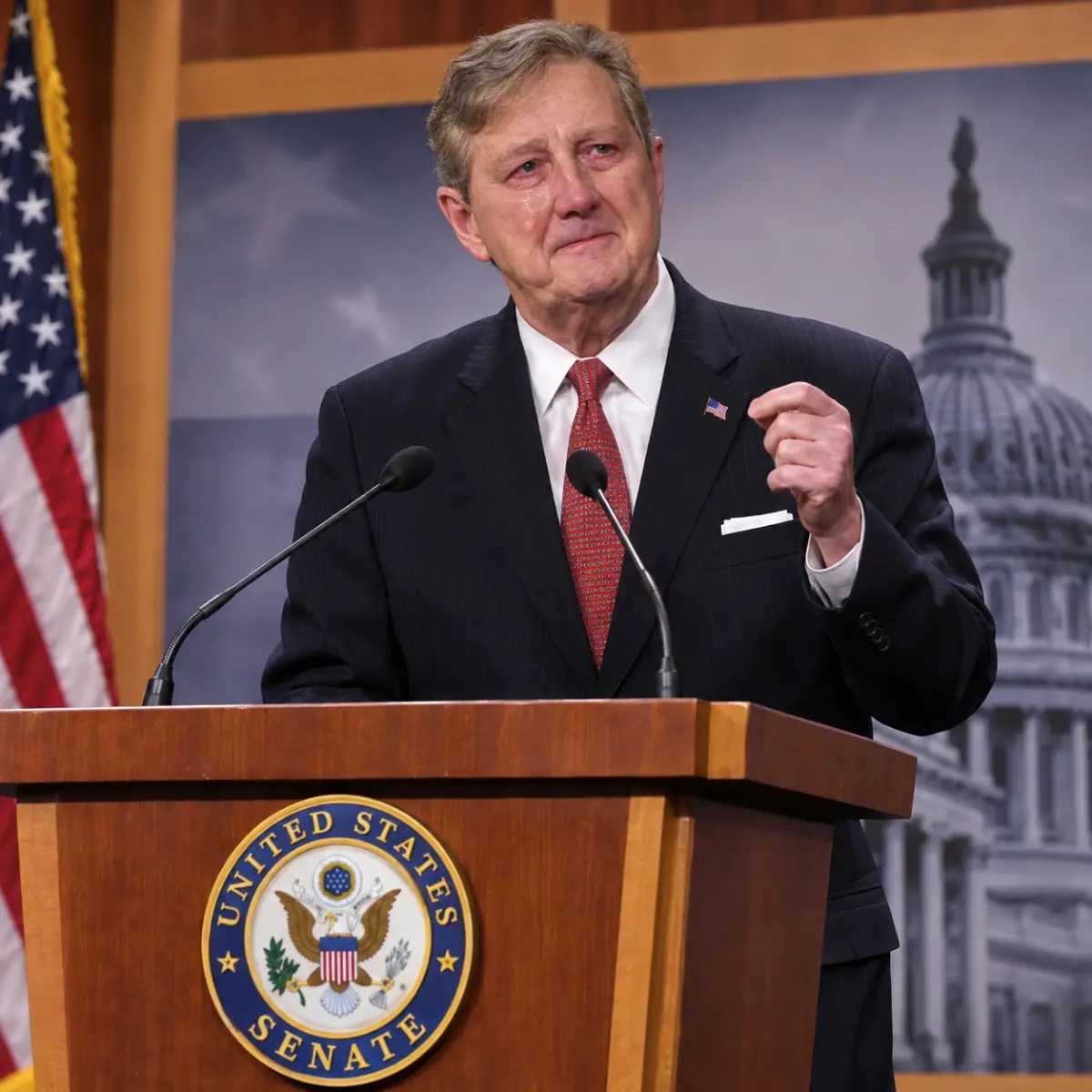
WASHINGTON, D.C. — In a city where political announcements often disappear beneath an endless stream of headlines, imagine a development powerful enough to stop conversations across Capitol Hill. Senator John Neely Kennedy of Louisiana, known for his sharp questions and unmistakable Southern delivery, becomes the center of an extraordinary political moment. The announcement appears straightforward at first, but its implications reach far beyond one senator, one committee, or one party.
The scene begins inside a crowded conference room overlooking Washington. Journalists wait beside television cameras while congressional staff exchange hurried messages. Nobody seems certain what Kennedy intends to say, and speculation spreads as the minutes pass. Some expect a routine policy statement, while others believe the Louisiana Republican is preparing to confront a larger problem within the federal government.
Then Kennedy enters, carrying a thin folder rather than the towering stack of documents some reporters anticipated. He approaches the microphone without ceremony and looks across the room. His expression is serious, but there is no theatrical anger in his voice. The announcement, he explains, concerns something that should matter to every American regardless of political affiliation: whether government institutions can demonstrate that they are using public money responsibly.
🇺🇸 AN ANNOUNCEMENT THAT CHANGES THE CONVERSATION
In this imagined Washington development, Kennedy is introduced as the leading advocate of a sweeping new congressional accountability initiative. The proposal calls for clearer reporting on federal spending, stronger follow-up procedures after audits, and more direct explanations when agencies fail to meet established performance standards. Its central objective is simple enough to understand, yet difficult to achieve in a government made up of thousands of programs and overlapping responsibilities.
Kennedy tells the assembled reporters that the country cannot afford to treat public accountability as a seasonal political slogan. Congressional hearings may reveal problems, but those discoveries mean little unless lawmakers follow through. He emphasizes that the public deserves to know not only where money was allocated, but whether the intended services were actually delivered.

The room grows quieter when Kennedy introduces the proposal's most controversial element. Federal agencies receiving substantial public funding would be expected to provide accessible explanations of major discrepancies identified through audits, including the corrective steps taken afterward. Rather than allowing unresolved findings to disappear into administrative correspondence, the initiative would establish a clearer process for tracking progress.
Supporters in this story immediately describe the idea as an overdue effort to strengthen public confidence. Critics, however, question whether additional reporting requirements could create another expensive layer of bureaucracy. The disagreement sets the stage for a much larger political battle, one that Kennedy appears willing to confront.
🔥 WHY KENNEDY'S MESSAGE RESONATES
Kennedy's real public persona has long been associated with direct questioning, memorable expressions, and skepticism toward complicated government explanations. Those characteristics make him a compelling figure in this imagined confrontation, especially when the debate turns toward a question that crosses ideological boundaries. Whether someone supports expanding federal programs or reducing government spending, both positions depend on the expectation that public resources will be handled responsibly.
Kennedy understands that the strongest arguments often begin with a simple principle. If a program is successful, officials should be able to explain why. If it is failing, they should identify the causes and determine whether the problems can be corrected. And when evidence suggests fraud or misconduct, investigations should establish responsibility through facts rather than political assumptions.
That final distinction becomes particularly important as reporters begin asking whether the proposed initiative is aimed at one political party. Kennedy rejects that framing in this story, arguing that accountability should not change depending on who occupies the White House or controls Congress. The standard, he insists, must apply equally to every administration.
⚡ THE SURPRISING OBSTACLE
Despite the enthusiastic response from some lawmakers, the initiative quickly encounters resistance. Committee members disagree over how much information agencies should disclose publicly, especially when audits involve sensitive investigations, private financial records, or national security matters. Others warn that imposing rigid deadlines could divert resources from the very services Congress wants agencies to improve.
The disagreement reveals a problem that cannot be solved through memorable speeches alone. Transparency must be balanced against privacy, oversight against administrative efficiency, and public pressure against the legal rights of individuals under investigation. Kennedy's supporters argue that these challenges can be addressed through carefully designed safeguards, while opponents demand more detailed evidence that the proposed system would work.
As the afternoon progresses, the debate becomes increasingly intense. Reporters initially expecting a brief announcement now find themselves following a complex policy discussion involving government auditors, agency administrators, congressional committees, and taxpayer advocates. The proposal has attracted attention, but attention is not the same as legislative success.
Kennedy faces a difficult choice. He can embrace the publicity and declare victory, or acknowledge that meaningful reform will require negotiation with colleagues who disagree with him. In this story, he chooses the second path, announcing that the initiative will undergo further review before formal legislative action.
😱 THE UNEXPECTED MESSAGE THAT SILENCES THE ROOM
Near the end of the conference, a reporter asks Kennedy whether he believes Washington has become too divided to accomplish anything significant. The question draws murmurs from the audience because it touches the frustration surrounding nearly every major legislative dispute. Kennedy pauses, glances at his notes, and offers an answer that shifts the discussion away from party politics.
He argues that the public should not measure congressional success only by the number of confrontations that dominate television coverage. A difficult question can expose a problem, but solving it requires evidence, cooperation, and sustained attention. A successful reform, he suggests, is one that continues working long after the cameras leave.
The response surprises observers expecting a more combative conclusion. Kennedy has not abandoned his sharp style, but he has redirected it toward a challenge that includes his own colleagues. If Congress demands accountability from government agencies, lawmakers must also be prepared to explain the outcomes of their oversight efforts.
That message becomes the emotional center of the imagined announcement. The senator's most consequential demand is not that another politician admit defeat, but that the institutions responsible for protecting public resources demonstrate measurable progress.

❤️ WHAT THE ANNOUNCEMENT REALLY MEANS
As Kennedy steps away from the microphone, the room begins buzzing with competing interpretations. Supporters see an opportunity to build a stronger system of public oversight, while critics remain concerned about implementation costs and unintended consequences. Neither side can claim the issue has been settled, because the proposal has only begun its journey through the political process.
The larger lesson is that government accountability is not established by a single announcement. It requires clear laws, independent investigations, reliable evidence, and institutions willing to correct their own mistakes. Public confidence grows when those mechanisms produce results that citizens can examine rather than promises they are simply asked to trust.
In the final scene, Kennedy leaves the conference room as reporters continue debating whether his initiative can survive Washington's political divisions. The announcement has created excitement, but its ultimate importance remains uncertain. The senator's final message lingers after he disappears into the hallway: the value of public service is measured not by how loudly leaders speak, but by what their actions accomplish.
And perhaps that is the most surprising part of the entire story. The imagined confirmation that captured everyone's attention was never meant to celebrate one politician. It was meant to ask whether Washington could finally agree that accountability belongs to everyone.