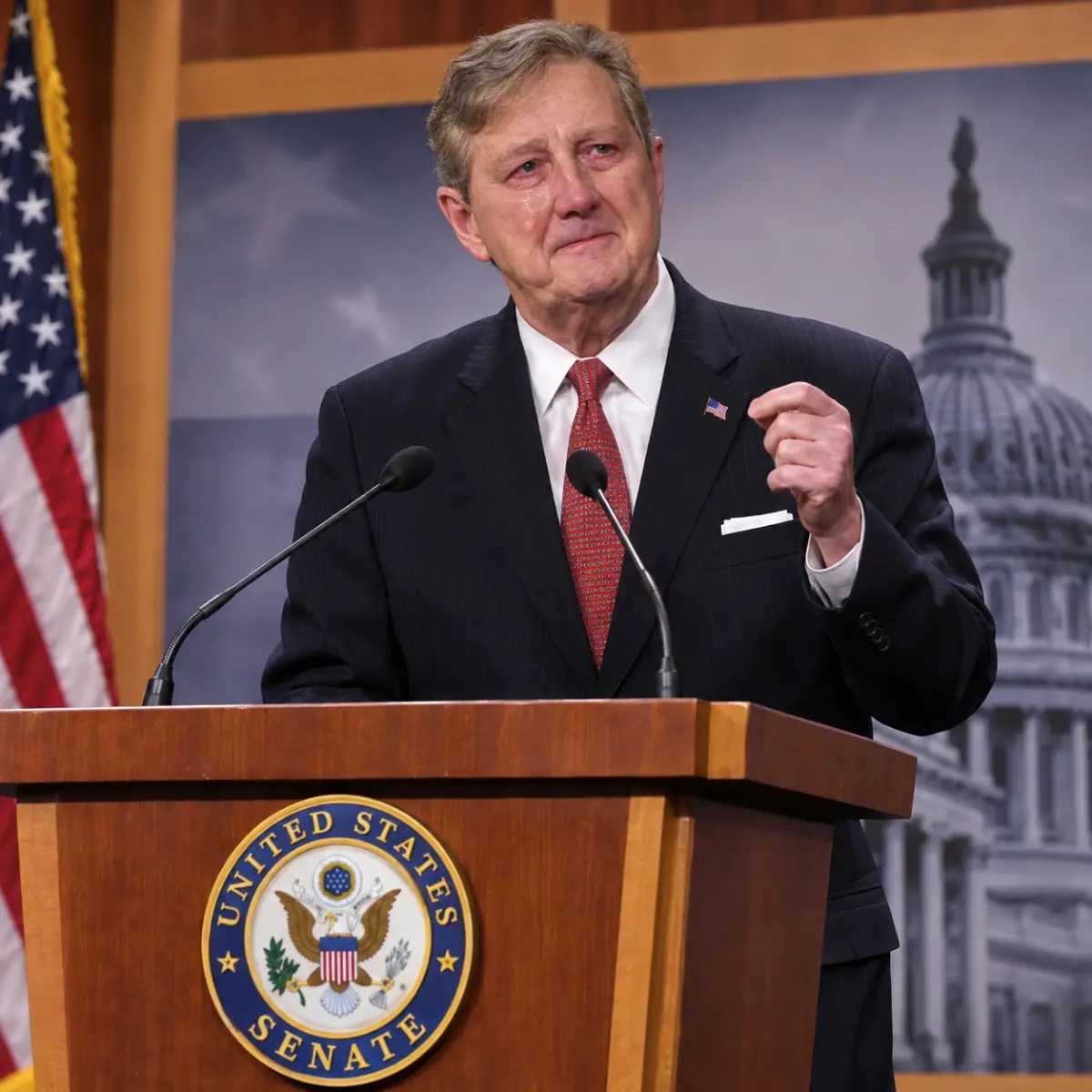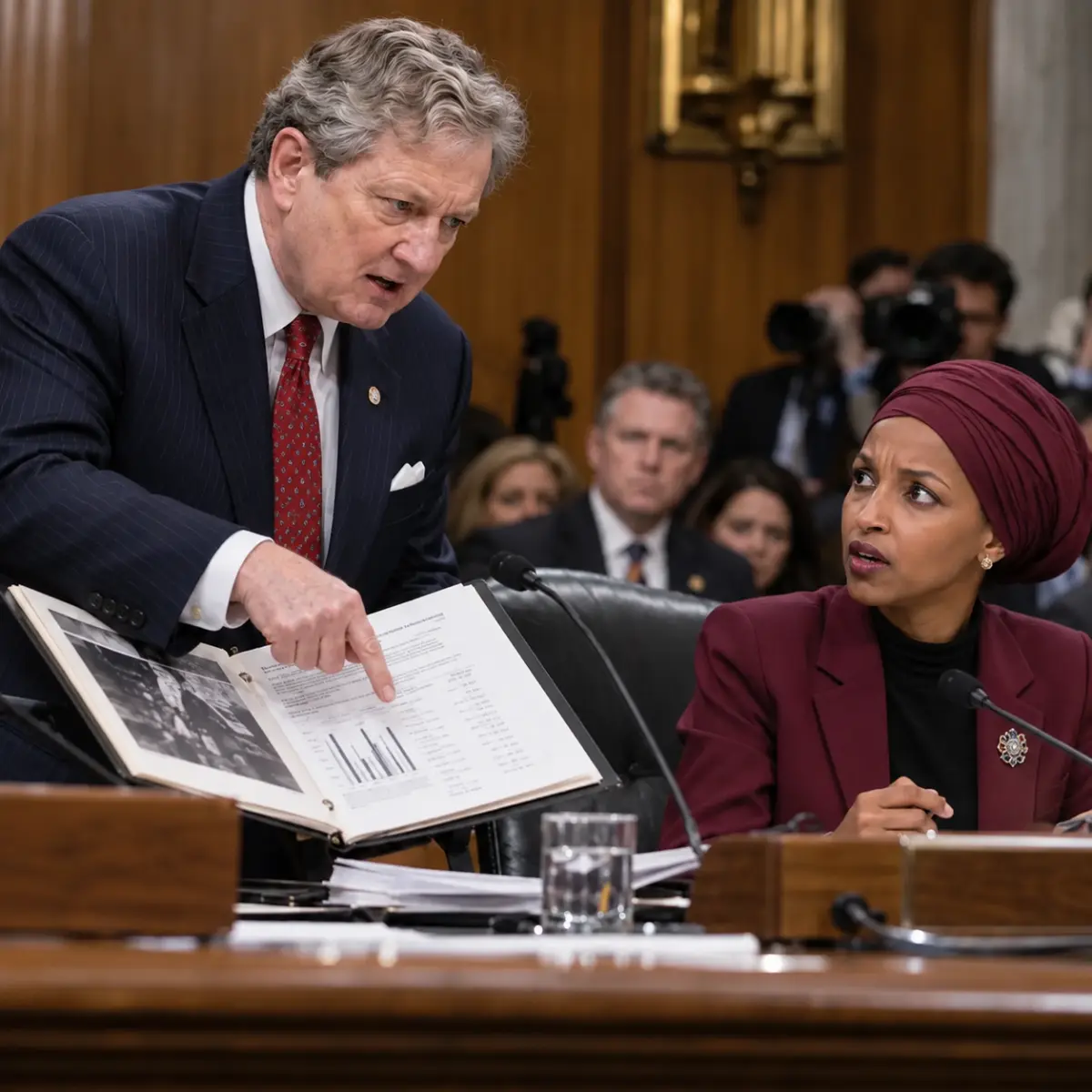
WASHINGTON, D.C. — Imagine a congressional hearing so tense that even the most experienced political observers struggle to predict what will happen next. The subject is Minnesota's sprawling public-program fraud controversy, an issue that has generated serious questions about oversight, taxpayer protections, and government responsibility. At the center of this imagined confrontation stands Louisiana Senator John Neely Kennedy, preparing to ask a question that could transform an already heated debate.
Across the room sits Minnesota Representative Ilhan Omar, a prominent Democratic lawmaker whose political career has frequently placed her at the center of national controversy. In this story, she has been invited to participate in a special congressional discussion about federal oversight and the responsibilities of elected officials. Kennedy appears determined to examine how government programs can become vulnerable to abuse, while Omar emphasizes the importance of protecting legitimate beneficiaries from the consequences of criminal misconduct.
The tension between these positions becomes the defining feature of the hearing. Both lawmakers recognize that fraud must be investigated, but they disagree over how political leaders should discuss the problem and what reforms should come next. As the cameras begin recording, the audience senses that the exchange could become one of the day's most closely watched moments.
🔥 THE MINNESOTA SCANDAL THAT RAISED NATIONAL QUESTIONS
Minnesota's public-program fraud controversies provide a serious backdrop for this imagined political drama. Real investigations have raised concerns about weaknesses in oversight systems, the verification of claims, and the difficulty of detecting suspicious activity before significant public resources are lost. The cases have also prompted arguments over whether government agencies responded quickly enough to warning signs.
One important distinction must remain clear: the existence of fraud involving particular organizations or individuals does not establish wrongdoing by unrelated elected officials, communities, or beneficiaries. Criminal responsibility requires evidence connecting specific people to specific conduct. That principle becomes especially important when politically sensitive investigations attract national attention.
In this story, Kennedy begins by discussing the responsibilities of agencies that distribute public funds. He asks how auditors can detect suspicious transactions, whether officials are required to report warning signs, and what happens when those warnings are ignored. His questions are direct, but the answers reveal a complicated system in which responsibilities may be divided among federal, state, and local institutions.
Omar responds by arguing that the solution must protect both taxpayers and people who depend on legitimate government assistance. She emphasizes that investigations should target actual wrongdoing rather than stigmatize entire communities. Her position introduces a second concern into the debate: preventing fraud without undermining public trust in essential services.

⚡ KENNEDY'S QUESTION CHANGES THE ATMOSPHERE
As the hearing progresses, Kennedy listens while witnesses describe reporting procedures, administrative safeguards, and the challenges of identifying fraudulent claims. Several explanations rely heavily on technical language, leaving the central issue unresolved. The senator appears increasingly interested in understanding not merely how the oversight system was designed, but how it performed when confronted with suspicious activity.
Then Kennedy turns toward Omar and asks the question that becomes the turning point of the imagined exchange:
“Congresswoman, if we agree that innocent families deserve protection and taxpayers deserve accountability, why can't we demand both without turning the investigation into a political fight?”
The room becomes unusually quiet. The question is not an allegation that Omar participated in fraud, nor does it suggest that she possesses information about criminal activity. Instead, it challenges the political framing of the controversy and asks whether two objectives often presented as competing priorities can coexist.
Omar pauses before responding. She argues that protecting families and pursuing criminals are compatible goals, but that the language lawmakers use matters. In her view, responsible oversight must distinguish between individuals accused of misconduct and the broader populations served by government programs.
Kennedy listens carefully, then presses the issue further. If both sides agree on those principles, he asks, what prevents Congress from establishing stronger safeguards while protecting due process and preventing discrimination? The question redirects the hearing from accusations toward the practical details of reform.
🇺🇸 THE DEBATE BECOMES BIGGER THAN TWO LAWMAKERS
The imagined confrontation now centers on an issue that extends beyond Minnesota. Federal and state governments administer enormous programs involving healthcare, nutrition, education, housing, and social services. Each program depends on systems capable of verifying eligibility, tracking expenditures, and detecting suspicious activity without creating unnecessary barriers for legitimate recipients.
Kennedy argues that accountability cannot depend entirely on officials discovering problems after money has disappeared. Effective oversight, he suggests, should identify unusual patterns early, establish clear reporting obligations, and ensure that agencies respond when credible warnings emerge. He also emphasizes the importance of measuring whether reforms actually reduce losses.
Omar challenges lawmakers to consider the consequences of poorly designed enforcement measures. Excessive paperwork, unclear eligibility rules, or indiscriminate investigations could delay assistance to families who have done nothing wrong. She argues that improving government administration requires careful attention to both financial integrity and public access.
Their disagreement produces an unexpected realization. Stronger oversight and fair treatment are not necessarily opposing objectives, although achieving both can require difficult policy choices. The challenge is designing a system that identifies misconduct accurately while preserving the rights of everyone involved.
😱 THE MOMENT THAT SURPRISES THE ENTIRE HEARING
Just as the committee chair prepares to move to another topic, Kennedy asks for a final opportunity to speak. Observers expect him to challenge Omar with another pointed question, perhaps attempting to secure a political advantage before the cameras. Instead, he directs his attention toward the government officials seated at the witness table.
He asks whether the agencies involved can provide a clear timeline showing when warning signs first appeared, what actions were taken, and which corrective measures followed. The request shifts the burden of explanation toward the institutions responsible for administering and monitoring the programs. It also introduces a standard that can be evaluated through documents rather than competing political narratives.
The witnesses acknowledge that answering such questions would require reviewing records across multiple agencies. Kennedy responds that this is precisely why the committee should request the documentation. Without a reliable timeline, lawmakers cannot distinguish between failures of policy design, administrative mistakes, deliberate misconduct, and weaknesses in enforcement.
Omar agrees in principle that accurate records and independent oversight are essential. She adds that any review should be conducted fairly and should not presume guilt before investigators establish the facts. For a brief moment, the confrontation becomes less about which politician can dominate the discussion and more about what evidence Congress needs to perform its responsibilities.
🔥 THE FINAL QUESTION NOBODY EXPECTED
As the hearing approaches its conclusion, Kennedy returns to the central issue. He acknowledges that politicians can spend hours arguing over who deserves blame, but says the public ultimately needs to know whether the same failures could happen again. His final question is directed not only toward Omar, but toward every lawmaker participating in the proceedings.
“When the next warning sign appears, will the people responsible recognize it, act on it, and stop the damage before taxpayers pay the price?”
The question leaves no room for an easy partisan victory. Answering it requires lawmakers to examine oversight rules, administrative resources, investigative procedures, and the effectiveness of previous reforms. It also demands a willingness to evaluate future results rather than treating a dramatic hearing as proof that the problem has been solved.
Omar responds that preventing fraud must remain a priority, while maintaining that enforcement should be grounded in evidence and respect for civil rights. Kennedy reiterates that public officials must be prepared to explain how taxpayer money is protected. The exchange ends without either lawmaker conceding the broader political argument, but with a clearer understanding of the questions that meaningful oversight must address.

🇺🇸 THE REAL LESSON BEHIND THE POLITICAL DRAMA
The most important outcome of this imagined hearing is not a viral confrontation or a memorable remark. It is the recognition that government fraud investigations must be serious, evidence-based, and focused on the individuals and systems actually responsible. Political disagreement may shape how lawmakers approach reform, but it cannot replace the work of investigators, auditors, prosecutors, and courts.
Minnesota's fraud controversies deserve careful examination because public money should reach the people and services for which it was intended. At the same time, accusations against individuals must not be treated as established facts without supporting evidence. Protecting taxpayers and respecting due process are both essential parts of a credible accountability system.
As the committee adjourns, Kennedy gathers his documents while Omar speaks quietly with members of her staff. Reporters continue debating which politician delivered the stronger performance, but the most consequential issue remains unresolved. The real test will come when officials must demonstrate whether oversight improvements are effective.
And that is the final twist of the story: the question that changes the debate is not who wins the argument, but who will take responsibility for preventing the next failure.